Showing posts with label Hinduism. Show all posts

Sunday, February 4, 2018

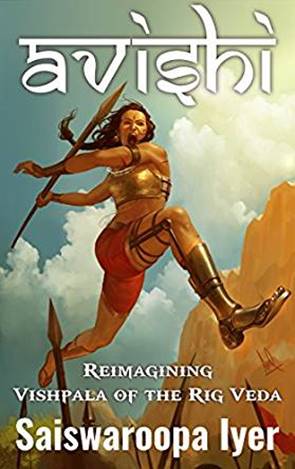
Avishi by Saiswroopa Iyer

 Avishi: Reimagining Vishpala of the Rig Veda

By Saiswroopa Iyer
 Category: fiction: mythology: Hinduism
Age: +13
Buy from: Amazon US, Amazon IN


This book is written by Saiswaroopa Iyer, and is the second book she has written. I liked her first book also a lot, so I decided to give this book a try. I also picked it because the book’s title itself was extremely interesting. The title of the book is ‘Avishi: Vishpala of Rig Veda Reimagined’. I have never heard of Vishpala, and so the title intrigued me. I love the book, and so far, I would recommend you to place it on top of your ‘To read’ list. This fabulously written book revolves around the Avishi, whose life is based on the life of Queen Vishpala, a valiant woman who fought against Khela. Khela was an evil king who wanted to change the rules and regulations that everyone followed, and twist them according to his tastes. During a battle, Vishpala loses a leg, and has it replaced with a metal leg. Even though she now has a metal leg, it does not stop her from fighting Khela at the end. I loved this book, and it has inspired me. The way Avishi fought even with serious injuries, and her leadership should be a lesson to all of us. Saiswaroopa Iyer was able to build the plot up well, as towards the end when Avishi and Khela fought, I was holding my breath, waiting for how it would end.

[this book has been included in our January 2018 edition of eGranth]

I have written a longer review of Avishi here.

© 2018, Anvita Agarwal. All rights reserved.

Wednesday, January 24, 2018

Avishi: Vishpala of Rig Veda Reimagined, by Saiswaroopa Iyer

Avishi: Vishpala of Rig Veda Reimagined, by Saiswaroopa Iyer

Avishi, Vishpala, these are names you may not have heard before. This book talks about Vishpala, a queen mentioned in the Rig Veda, who lost her leg during a fight and then had her leg replaced with a metal one. Saiswaroopa Iyer, the author, has reconstructed Vishpala’s life through Avishi and also imagined some of it, to present before us this wonderful book.

Saiswaroopa Iyer has written another book called ‘Abhaya’. Both her books have one thing in common - both talk about tales of women with unimaginable courage. When you start reading Avishi, you will be enthralled by the immense hardships she had to face and her bravery in facing those hardships without flinching. This gives a message to everyone, that women aren’t weak and never were. It dispels that misconception and inspires children who read it.

Here is a gist of the story.

Thursday, November 2, 2017

Brahmavaivarta Purana, by Bibek Debroy

Brahmavaivarta Purana, translated by Bibek Debroy

This is the fifth purana review I’m writing, and is the second Rajasika Purana I am going to be writing about. Rajasika Puranas are Mahapuranas that glorify Brahma, instead of Lord Shiva or Lord Vishnu. If you want to know more about the Puranas you can go to my first Purana review, of the Shiva Purana. This is a unique Purana as it is the only Purana that has referred to Krishna as ब्राह्मण (Brahman), the divine essence. We cannot describe the divine essence brahman, as it has no traits that can be described. It is said that it is from him other gods and goddesses. They have then described the process of creation that is pretty much the same. There are four parts to it. They are the Brahma khanda, the Prakriti khanda, the Ganesha khanda and the Sri-krishna-janma khanda. The only part that I found a little unusual is that they have mentioned that at the start that Saraswati and Lakshmi were married to Lord Narayana! I have usually heard that Ma Saraswati was married to Brahma. They have said that Brahma was married to Savitri. This Mahapurana is eighth in the list of the Puranas’, and consists of eighteen thousand shlokas.

MY FAVOURITE STORIES

The first part of the Purana, the Brahma khanda talks about the creation of the gods, goddesses, men, etc. The Prakriti khanda talks about the different ways through which you can worship the gods and goddesses and their nature. It also describes the different kinds of hells, heavens, and the cures of different diseases. The Ganesha khanda, as the name suggests, is more about Lord Ganesha and some common stories associated with him. It also talks about the various hymns to him and his conversations with Sage Bhrigu. The last khanda, the Sri-krishna-janma khanda, is more on Lord Krishna’s birth and deeds. I liked the Ganesha khanda the most, because I have always loved stories that are related to Lord Ganesha. From the Ganesha khanda, my favorite stories are the ones about how Ganesha’s head was cut off, and how Ganesha came to be known as Ekadanta.

How Ganesha’s head was cut off:

Parvati wanted a child, so she performed the punyaka vrata, and Lord Krishna himself took birth as her child. When the child was born, many gifts were brought, and many people came to visit the child. Among those people was Shani (Saturn), the son of Surya. When he approached the child, he bent his head and did not look at the child. When Parvati questioned him on his strange behavior, Shani explained, “I have been cursed that whatever I directly look at will get destroyed immediately. I was cursed by Chitraratha, the daughter of the gandharva king, and my wife, as I neglected her.” Parvati took it lightly and laughed it off. She asked him to look at her. Tempted, Shani looked at the child, not Parvati from the corner of his eye. The damage was done. The next moment the child lay headless in Parvati’s lap. Parvati was shocked, and fainted. Krishna mounted Garuda and went northwards. He found a bull elephant sleeping. He sliced the head of the elephant, who was Airavata, and rejoined it with the child’s body. Parvati was happy, but she cursed Shani that he would be angahina, without a limb. That child was none other than Lord Ganesha.

How Ganesha came to be known as Ekadant: 

Parashurama was the son of Sage Jamadagni, and Jamadagni had been killed by Kartavirya Arjuna who was a kshatriya. Parashurama therefore vowed to get rid of all the kshatriyas in the world. As Shiva was Parashurama’s guru, after performing his vow, he decided to pay his respects to Shiva. He went to Shiva’s abode, Kailasha, but was stopped from entering it by a respectful Ganesha. He said that Lord Shiva was sleeping, and Parashurama ought to wait for a while. Parashurama tried making Ganesha see reason, but he later got angry when Ganesha refused. They started fighting, and Ganesha extended his trunk to a long length and hurled Parashurama onto Earth. Seeing his chance, Parashurama let the parashu loose. The parashu was a weapon given by Lord Shiva himself to him, so it could not be completely repulsed. It broke Ganesha’s left tusk. Since he has one (eka) tusk (danta), he came to be known as Ekadanta.

I really enjoyed this Purana and these two stories. They are crisp and well written. I enjoyed every single word of it, and did not feel bored. These abridged translations of the Puranas help you know the basic information you should be knowing about the Purana and may help you understand the unabridged ones better. They are not very long, only a hundred pages long and can be completed in two hours or so if you read them without a break. I loved the short stories as they were interesting. Each Purana has different versions of the same story. When you read the story about Ganesha that I have mentioned above, you will find them very different from what you might have heard of the same tale. I have read five Purana’s so far, and each Purana has been more interesting than the other.


© 2017, Anvita Agarwal. All rights reserved.

Sunday, April 30, 2017

Matsya Purana, by Bibek Debroy

Matsya Purana

Translated by Bibek Debroy

The Matsya Purana is my third review of the Puranas written by Bibek Debroy. He had translated the unabridged version of the whole Mahabharata in English, with eleven volumes, the eleventh volume being the Harivamsha. Earlier he has translated an abridged version of the eighteen Mahapuranas. I have reviewed two so far, and this is the third I’m going to be reviewing. To know the basic facts on the Puranas, you can read the earlier reviews I’ve written. Let me start by telling you the basics you should know about the Matsya Purana. Firstly, the Matsya Purana is the sixteenth Purana in order, not of importance. Secondly, the Matsya Purana is a tamasika Purana, which means it praises Shiva more, though it has the name of one of Vishnu’s avataras. In reality, it is Vishnu who is narrating this Purana to Vaivasvata Manu. It consists of fifteen thousand shlokas in all. It has a few similar stories to the Shiva Purana. In this Purana, I didn’t find the stories as interesting as a few interesting things shared in the book. I’ll mention them to you

Firstly I found the facts on giving daan very interesting. You will come upon them when you have read most of the book and you are nearing the end. There are sixteen ways of giving daan. All of them are listed below.
  1. Tulapurusha : The donator of the daan should sit on the scale and gold should be placed on the other side until both the scales are balanced equally.
  2. Hiranyagarbha : A pot full of gold is donated.
  3. Brahmanda: A universe made out of gold is donated.
  4. Kalpapadapa: A tree made of gold is donated.
  5. Gosahasra: A thousand cows are donated.
  6. Kamadhenu: A cow and a calf made of gold are donated.
  7. Hiranyashva: A horse made of gold is donated.
  8. Ashvaratha: A horse and four chariots constructed of gold are donated.
  9. Hemahastiratha: An elephant and a chariot made of gold are donated.
  10. Panchalangalaka: Ten ploughs are donated, five made of gold and five made of wood.
  11. Dhara: A golden model of the Earth is donated.
  12. Vishvachakra: A golden model of the Universe in the form of a wheel is donated.
  13. Mahakalapalata: Ten creepers of gold are donated.
  14. Saptasagara: Seven pits are made in the ground, representing seven oceans. The first pit has a little bit of salt, the second milk, the third clarified butter, the fourth molasses, the fifth curds, the sixth sugar and the seventh holy water. An idol of a god or goddess is placed in each. Brahma in the first, Vishnu in the second, Shiva in the third, Surya in the fourth, Yama in the fifth, Lakshmi in the sixth and Parvati in the seventh. The pits are then covered with jewels to the brim.
  15. Ratnadhenu: A cow made of gold with different parts made of jewels is donated.
  16. Mahabhutaghata: A pot made of gold filled with jewels is donated.

The second thing I loved the most was when he described the time a house should be built. The points you have to remember while building a house are:
  • The building of a house should never happen during Chaitra, as the person who does this will inflict a terrible disease.
  • The month of Vaishakha is a good time, as a person will have many cows.
  • An individual who begins in Agrahayana has full granaries, in Magha attains all sorts of riches and in Falguna obtains gold and sons.
  • Servants and animals are owned by the person who starts in the month of Ashada.
  • If you start to build a house in Jyaishta and Shravana you will die soon; in Bhadra you will suffer all manner of losses; in Ashvina your wife will die and in Pousha your goods will be stolen.
One story we commonly know is the story of Sanjana and Surya. There is a particular part that we don’t know about. When Sanjana took the form of a mare and was meditating so that Surya’s radiance would reduce. After Sanjana’s father had chipped a small bit of his radiance, Surya took the form of a horse and joined Sanjana. At that time, Sanjana gave birth to two twin sons. Those two twins were the Ashvini twins. This has not been mentioned in many versions. This was a part of the story I liked, as I haven’t read this in the versions of this story which I’ve read.

The last part I liked was when Bibek Debroy talks about ब्राह्मण (Brahman). During the creation of the universe, there was darkness and the Brahman. We cannot describe the divine essence brahman, as it has no traits that can be described. The Matsya Purana says that the brahman repelled all the darkness, and divided itself into three parts. Those three parts are known as Brahma, Vishnu and Shiva. All the Puranas have different versions on the creation of the Universe, if you happen to read them. This I found to be the most interesting of the versions I’ve read of. It talks about the Brahman, which is the divine essence said to be formless. This is the part I enjoyed the most. It told me about Brahman, a term I had vaguely heard about.

These parts were my favourite. This book was one of the best from the other two Puranas. This is easy to understand, and can be read by kids. It gives us a lot of information on our ancient texts, the Puranas. Bibek Debroy’s Mahabharata, though long is written beautifully in simple English. One should really read the books written by Bibek Debroy. Also read my other two reviews on the Puranas:


Kindle India, Kindle US,


Preview:


© 2017, Anvita Agarwal.

Sunday, April 16, 2017

Padma Purana, Translated by Bibek Debroy

Padma Purana (Great Epics of India: Puranas Book 2)

Translated by by Bibek Debroy, Dipavali Debroy

Namaste.
I am Anvita and I would like to share with you some information about the Puranas, one of the sacred texts of Hinduism. Before I start, I would like to give you a general idea of a Purana. A Purana is one of the sacred texts of Hinduism. The Mahabharata, the Ramayana and the Puranas are together known as Itihasa, something that happened in the past. As we all know, the Ramayana was written by Sage Valmiki and the Mahabharata was composed by Krishna Dvaipayana. The Puranas were also written by the same person, Krishna Dvaipayana. This great sage was the offspring of Satyavati and Rishi Parashara. He was originally named Krishna Dvaipayana, as he his complection was dark (Krishna) and he was born on an island (Dvaipayana). Later on, he was titled Vedavyasa or Vyasadeva as he divided one of the most sacred texts of Hinduism, the Vedas. Hence, he was known as the one who divided the Vedas (Vyasa = dividing). There are eighteen Puranas that are given more importance, because of five characteristics they contain. The Puranas are as follows:
  1. Brahma Purana
  2. Padma Purana
  3. Vishnu Purana
  4. Shiva Purana
  5. Bhagvata Purana
  6. Narada Purana
  7. Markandeya Purana
  8. Agni Purana
  9. Bhavishya Purana
  10. Brahmavaivarta Purana
  11. Linga Purana
  12. Varaha Purana
  13. Skanda Purana
  14. Vamana Purana
  15. Kurma Purana
  16. Matsya Purana
  17. Garuda Purana
  18. Brahmanda Purana

The characteristics are listed below,
1. The original creation of the universe (sarga).
2. The periodical destruction and recreation of the universe (pratisarga)
3. The different eras (manvantara)
4. The history of the solar dynasty (suryavamsha) and the luna dynasty (chandravamsha)
5. The royal genealogies (vamshanucharita)

The Padma Purana is the second longest purana with fifty-five thousand couplets. The Padma purana is divided into sections – Srishti kanda, bhumi khanda, svarga khanda, patala khanda and Uttara khanda. The Padma Purana is a Sattvika Purana, as it glorifies Lord Vishnu. The Padma Purana has many stories and less facts, which makes it extremely interesting. Bibek Debroy starts the purana with the bhumi kanda. He usually starts the puranas with Lomaharshana narrating the Purana to a group of sages.

There are many stories, most of them, which I enjoyed, but the best stories to me, are two of them.

These stories come when you have finished about half of the whole book. They come during the story of Sage Chyavana. Sage Chyavana decides to go on a pilgrimage to visit all the tirthas, as he believed, if he visited them, he would attain true knowledge. On his journey, he stopped to rest under a banyan tree. The Banyan tree was the house to a family of parrots. The male and female parrot had four sons. Every day they would go to different places in search of food. Their names were Ujjvala, Samujjvala, Vijjvala and Kapinjala, respectively. On this particular day, they happened to visit places where strange sights met them. They would narrate their story, and ask their father Kunjala to explain the strange sights they saw. I enjoyed the stories of Samujjvala and Kapinjala.
Samujjvala’s story: He went to the Himalayas to search for food, in one particular valley that was frequently visited by sages and apsaras. There was a lake called the Manasa sarovara. He waited there and several swans arrived. Some were black and the others were white. They were followed by fierce looking, ugly women. The black swans went to bathe. The women stood outside and laughed. A large white swan came out of the water followed by three swans. They took off, followed by the other white swans. Meanwhile a hunter arrived at the spot and sat down, followed by his wife. The wife didn’t recognize the husband, as he was better looking than before. The husband explained to her that he had bathed in the Narmada sangam, the meeting point of the rivers Narmada and Reva. He guided his wife there, and the swans with the women followed. The swans bathed, and the black swans became snow – white. The women when did so died.

The explanation for this: Narada visited Indra in heaven. Indra questioned Narada about which of all the tirthas was the best. Narada was confused and couldn’t answer it so Indra summoned all the tirthas to his court. He posed a question to the tirthas that which one could purify the worst of sins. The tirthas suggested Prayaga, Varanasi, Pushkara and Arghyatirtha. There is a story connected to this. One day, a kshatriya named Vidura killed a brahmana in a fit of anger. This was a great sin, so he visited many tirthas, but his sin wasn’t forgiven. On his journey, he met a man named Chandrasharma. He had killed his teacher, and he too had visited many tirthas but his sin had not been forgiven. They decided to travel together. They met two more men, Vedasharma and Vanjula. One had married someone he should not have and the other was a drunkard. They journeyed together and a sage advised them to visit Prayaga, Arghyatirtha, Varanasi and Pushkara. They visited the tirthas and their sins were so bad that the tirthas became contaminated and followed the sinners in the form of black swans. The tirthas that were not contaminated followed the sinners in the form of white swans. The whole retinue went to the Manasa sarovara. This tirtha also took the form of a black swan and eventually made their way to the confluence of the rivers Narmada and Reva. When they bathed in this tirtha, they all were cleansed. The four women were the personifications of the four sins of the four women. When the sinners were pardoned, the sins died. The most sacred tirtha of all is the tirtha present at the confluence of the rivers Reva and Narmada, known as the Kubjatirtha.

Kapinjala’s story: He went to Mount Kailasa in search of food. Near one particular pond, he saw a woman seated on a boulder crying. From her tears sprouted lotuses. A sage picked those lotuses and offered them to Lord Shiva. After doing this, he danced and then sat and cried.

Explanation for this: There was an asura named Vihunda. He wanted to take revenge for his father’s death. He started doing a terrible tapasya. The gods were terrified and prayed to Vishnu. To help the gods, Vishnu took the form of a beautiful woman and distracted Vihunda. He fell hopelessly in love and asked Vishnu if he could marry her. Vishnu agreed and told Vihunda that first he would have to worship Shiva with seven crore Kamoda flowers, make a garland of them and give it to her. He agreed. He searched for Kamoda flowers but could not find them. His guru Sukracharya told him that Kamoda flowers didn’t grow on trees. They sprouted when a woman named Kamoda laughed, but when she cries, the flowers that emerge should not be touched. He told him where Kamoda could be found. The gods had no intention of allowing Vihunda to get the flowers. They told her that Vishnu was going to leave heaven and come down to Earth. The thought of Vishnu leaving heaven was so depressing that she started crying. Vihunda, not realizing that these were the flowers had sprouted from Kamoda’s crying, collected the flowers and worshipped Shiva. This act angered Parvati that she killed him.

The rest of the Padma Purana has stories of how punya can be obtained by simply cleaning Vishnu’s idol or removing darkness from it. A person who hears just the recitation of one shloka of the Padma Purana is forgiven of all his sins he may commit in the space of a single day. A lot of punya is also obtained if one donates a thousand cows to a brahmana or if he hears the recitation of one chapter of the purana. In the Kali yuga, punya can be obtained by listening to the whole Padma Purana being recited, giving alms or doing tapasya.


Kindle India, Kindle US,

Review of Shiva Purana


Preview:


© 2017, Anvita Agarwal. All rights reserved.
Saturday, June 22, 2013

Ruru and Pramadvara

Once three men were wandering in the forest. They were thirsty and saw a hermitage. They asked if anyone in there, if you are there then please give us some water. A beautiful woman came out of the hermitage and gave her water. Her name was Pramadvara. One of the men whose name was Ruru fell in love with Pramadvara. He told his friends to tell his father that he wants to marry Pramadvara. His father was very happy that his son found a bride. The next day he went to ask for Pramadvara's hand in marriage. Her father said yes but he told let me tell you the story of my daughter. Once I was walking back to Ashram. When I saw an abandoned baby. I thought this must be an Apsara's abandoned baby. I will take care of it till she goes in marriage. I took care of her for many years. This is the story of my daughter, that is why i named her Pramadvara. Your son can marry my daughter. A few days before her marriage, Pramadvara and her friends were playing. She stepped on cobra by mistake and it bit her. She suddenly fell dead. Her father saw that she was glowing even more brightly. Her father was crying and asked Ruru how did Pramadvara died.Ruru just ran inside the forest and told him to take care of her wife He prayed to God to restore his wife. Gods took pity and restored Pramadvara but on one condition you give half of your life to Pramadvara. Ruru agreed. Then they got married.